
Choosing a biodegradable phone case should be simple, but even many consumers are misled—over half believe any product labeled ‘biodegradable’ will vanish in nature without a trace. The truth is more complex and matters deeply for eco-conscious young professionals who value both durability and authentic sustainability. This article untangles scientific facts from greenwashing, giving you the clarity needed to pick cases that truly protect your device and the planet.
Table of Contents
- Biodegradable Products Defined and Debunked
- Material Types and Degradation Methods Explained
- Eco-Friendly Features and Real-Life Applications
- Environmental Impact and Cost Considerations
- Common Pitfalls and Wise Usage Choices
Key Takeaways
| Point | Details |
|---|---|
| Understanding Biodegradability | Biodegradability is complex and depends on various factors, including environmental conditions and material composition. Not all products labeled “biodegradable” are scientifically proven to meet rigorous standards. |
| Material Types | Biodegradable materials can be biobased or synthetic, each with unique degradation mechanisms. Awareness of specific types aids in discerning genuine sustainability. |
| Applications and Impact | Biodegradable products are increasingly utilized in industries like packaging and medical technology, driving innovation and reducing environmental impact. |
| Consumer Vigilance | To ensure true eco-friendliness, consumers should verify product claims, research certifications, and understand the environmental conditions necessary for effective biodegradation. |
Biodegradable Products Defined and Debunked
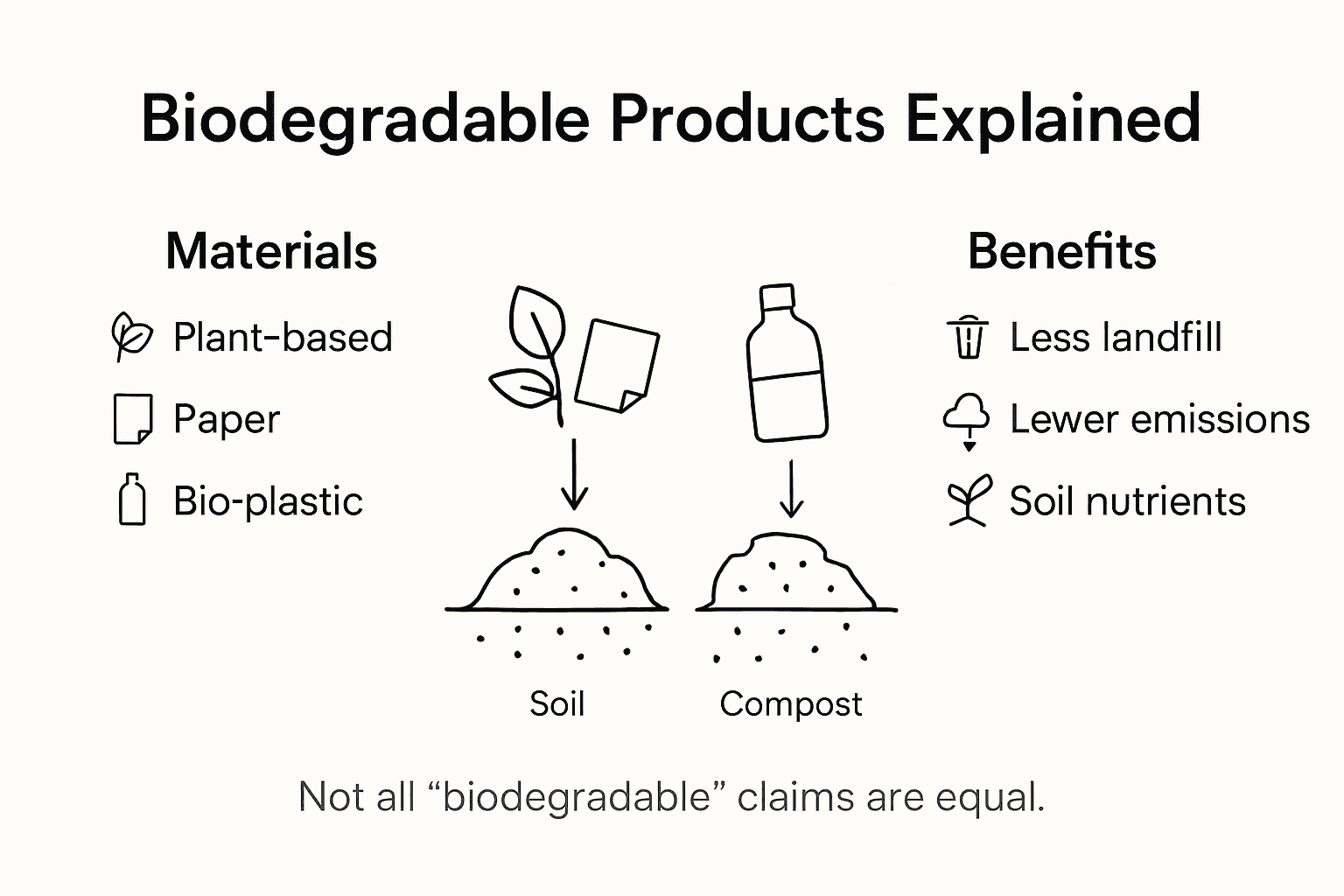
The term biodegradable sounds straightforward, but the reality is far more complex. Emerging scientific research reveals significant nuances about what truly constitutes a biodegradable product, challenging many widespread misconceptions consumers hold about environmental sustainability.
At its core, biodegradability refers to a material’s ability to decompose naturally through biological processes, breaking down completely into water, carbon dioxide, and biomass without leaving toxic residues. However, this seemingly simple definition masks tremendous variability. Scientific reviews demonstrate that biodegradation depends on multiple intricate factors, including environmental conditions, microbial populations, material composition, and specific decomposition mechanisms.
Key characteristics of genuine biodegradable products include:
- Complete decomposition without toxic byproducts
- Ability to break down within reasonable timeframes
- Minimal environmental impact during degradation process
- Transformation through natural microbial activity
Consumers must recognize that not all products labeled “biodegradable” meet rigorous scientific standards. Many manufacturers engage in greenwashing, using misleading terminology that suggests environmental friendliness without substantive proof. Understanding the nuanced science behind biodegradation helps make more informed purchasing decisions.
Pro tip: Always research product certifications and look for independent third-party verification of biodegradability claims before purchasing so-called eco-friendly products.
Material Types and Degradation Methods Explained
Biodegradable materials represent a complex and evolving field of sustainable technology, with diverse polymers offering unique environmental solutions. Scientific research reveals intricate details about different material types and their specific degradation mechanisms, challenging our understanding of how these materials interact with natural environments.

Two primary categories of biodegradable materials emerge: biobased polymers and synthetic biodegradable polymers. Biobased polymers originate from renewable sources like plant starches, cellulose, and agricultural waste, while synthetic versions are engineered to break down more efficiently than traditional plastics. Detailed polymer research demonstrates that degradation processes are influenced by complex environmental factors, including temperature, moisture, microbial activity, and specific material composition.
Key biodegradable material types include:
- Polylactic Acid (PLA): Derived from renewable resources like corn starch
- Polyhydroxyalkanoates (PHA): Produced through bacterial fermentation
- Starch-based polymers: Created from agricultural plant materials
- Cellulose-derived materials: Extracted from plant cell walls
Understanding these materials requires recognizing that biodegradation is not a uniform process. Different polymers degrade through distinct mechanisms:
Here’s a comparison of major biodegradable polymer types and their most common real-world uses:
| Polymer Type | Origin | Typical Applications |
|---|---|---|
| Polylactic Acid | Corn starch or sugarcane | Food packaging, cutlery |
| Polyhydroxyalkanoates | Bacterial fermentation | Medical implants, agriculture |
| Starch-based Polymer | Potato or maize starch | Shopping bags, films |
| Cellulose-derived | Plant cell walls (wood pulp) | Paper products, coatings |
- Aerobic biodegradation: Occurs in oxygen-rich environments
- Anaerobic biodegradation: Happens in oxygen-depleted conditions
- Enzymatic breakdown: Facilitated by specific microbial enzymes
- Hydrolytic degradation: Chemical breakdown through water interaction
Pro tip: Always check the specific environmental conditions recommended for a biodegradable product’s optimal decomposition to ensure proper disposal and maximum ecological benefit.
Eco-Friendly Features and Real-Life Applications
Biodegradable materials are revolutionizing multiple industries, offering sustainable alternatives that significantly reduce environmental impact. Recent scientific research highlights the expansive potential of biodegradable polymers across diverse applications, demonstrating how these innovative materials can transform traditional manufacturing and consumption patterns.
The practical applications of biodegradable technologies span several critical sectors:
- Packaging Industry: Replacing single-use plastics with compostable alternatives
- Agriculture: Developing biodegradable mulch films and seed coatings
- Medical Technology: Creating temporary implants and drug delivery systems
- Consumer Electronics: Designing sustainable protective accessories
Comprehensive studies of bioplastic technologies reveal significant potential for reducing carbon footprints, particularly in industries traditionally dependent on petroleum-based materials. The most promising applications emerge where environmental performance meets functional reliability. These materials are not just theoretical concepts but practical solutions addressing real-world sustainability challenges.
Key eco-friendly features that distinguish biodegradable products include:
- Minimal environmental persistence
- Reduced carbon emissions during production
- Ability to decompose without toxic residues
- Renewable source materials
- Lower energy consumption in manufacturing
Pro tip: When evaluating biodegradable products, look beyond marketing claims and request specific documentation about decomposition rates, environmental testing, and third-party certifications to ensure genuine sustainability.
Environmental Impact and Cost Considerations
Comprehensive life cycle assessments reveal complex trade-offs in biodegradable material production, challenging simplistic assumptions about environmental sustainability. While biodegradable technologies promise reduced ecological footprints, the reality involves nuanced calculations of energy consumption, raw material sourcing, and end-of-life environmental performance.
The economic landscape of biodegradable materials presents both opportunities and significant challenges:
- Higher initial production costs compared to traditional plastics
- Increasing price competitiveness as technology improves
- Potential long-term savings through reduced waste management expenses
- Growing market demand driving technological innovations
Detailed scientific evaluations demonstrate that sustainable bioplastic development requires holistic approaches balancing environmental benefits with economic constraints, addressing multiple interconnected factors. The most promising strategies involve:
- Optimizing agricultural practices for raw material production
- Developing energy-efficient manufacturing processes
- Reducing greenhouse gas emissions during production
- Improving mechanical performance of biodegradable materials
- Creating scalable production technologies
Key environmental considerations include:
Below is a summary of how production and environmental aspects differ for biodegradable versus traditional plastics:
| Aspect | Biodegradable Plastics | Traditional Plastics |
|---|---|---|
| Raw Materials | Renewable, plant-based | Fossil fuels (petroleum) |
| Carbon Footprint | Lower (potentially) | High |
| End-of-Life Impact | Compostable or decomposes | Persistent in landfills |
| Production Cost | Generally higher, decreasing | Low, stable |
- Carbon footprint reduction potential
- Water and energy consumption during production
- Waste management and decomposition characteristics
- Impact on natural ecosystems
- Renewable resource utilization
Pro tip: Conduct a comprehensive total cost of ownership analysis that considers not just upfront expenses, but long-term environmental and disposal costs when evaluating biodegradable product investments.
Common Pitfalls and Wise Usage Choices
Understanding the complex landscape of biodegradable products requires navigating multiple potential misconceptions and challenges, revealing that sustainability is far more nuanced than simple marketing claims suggest. Consumers and manufacturers alike must develop sophisticated perspectives that go beyond surface-level environmental promises.
Common misconceptions about biodegradable products include:
- Assuming all biodegradable materials decompose equally quickly
- Believing biodegradation happens automatically in any environment
- Overlooking the energy and resource requirements of production
- Expecting identical performance to traditional petroleum-based materials
- Thinking biodegradable automatically means completely eco-friendly
Scientific research highlights critical considerations for wise biodegradable product usage, emphasizing the need for informed decision-making. Successful implementation requires understanding:
- Specific degradation conditions for each material
- Appropriate disposal infrastructure
- Realistic performance expectations
- Total environmental lifecycle impact
- Technological and economic constraints
Strategic approaches to maximizing biodegradable product benefits include:
- Conducting thorough research before purchasing
- Understanding specific material characteristics
- Matching products to appropriate disposal environments
- Prioritizing materials with proven sustainable production methods
- Supporting ongoing technological innovations
Pro tip: Always verify the specific environmental conditions required for complete biodegradation and confirm appropriate local waste management capabilities before investing in biodegradable products.
Discover Sustainable Protection With Tallpinecases
The challenge of choosing truly biodegradable products means understanding the science behind materials and their right disposal conditions. If you want to avoid greenwashing and make a real environmental impact, selecting phone cases made from verified plant-based, compostable materials is essential. Tallpinecases offers exactly that by combining eco-friendly innovation with stylish, durable designs that meet the high standards of biodegradability discussed in the article.
Explore our unique collection of protective phone cases and accessories crafted from renewable resources. Shop now at Tallpinecases to enjoy eco-conscious products that support sustainable living. Take advantage of current offers like Black Friday discounts and free shipping, and join a community committed to reducing plastic waste through responsible choices. Visit https://tallpinecases.com to find your next biodegradable phone case today.
Frequently Asked Questions
What does biodegradable mean?
Biodegradable refers to a material’s ability to decompose naturally through biological processes into water, carbon dioxide, and biomass, without leaving toxic residues.
Are all biodegradable products environmentally friendly?
Not all biodegradable products meet rigorous scientific standards. Some may be labeled as biodegradable for marketing purposes but do not decompose effectively or leave no harmful residues.
How long does it take for biodegradable materials to decompose?
The decomposition time for biodegradable materials depends on various factors, including environmental conditions, microbial activity, and the material’s composition. Some may break down within weeks, while others take months.
What are the main types of biodegradable materials?
The main types of biodegradable materials include biobased polymers such as Polylactic Acid (PLA) from corn starch, Polyhydroxyalkanoates (PHA) produced through bacterial fermentation, starch-based polymers, and cellulose-derived materials extracted from plants.